


Category: Knowledge


Intensity and embeddedness: Two dimensions of equity approaches in multi-stakeholder forums
This paper introduces a novel approach to studying multi-stakeholder forums (MSFs) in the context of land use and land-use change, focusing on their equity implications. The authors analyse MSFs based on two key characteristics: the extent to which local communities are actively involved (intensity) and the extent to which the forum is integrated into broader societal or governmental processes (embeddedness). By employing these analytical tools, the paper offers nuanced insights into how different MSF approaches function and their impact on equity, going beyond simplistic categorizations and providing a deeper understanding of MSF dynamics.
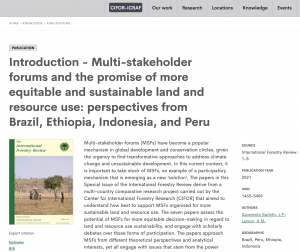
Introduction – Multi-stakeholder forums and the promise of more equitable and sustainable land and resource use: perspectives from Brazil, Ethiopia, Indonesia, and Peru
This Special Issue of the International Forestry Review presents a multi-country comparative research project by CIFOR, exploring the potential of multi-stakeholder forums (MSFs) as participatory mechanisms for sustainable land and resource use. The seven papers analyse power inequalities inherent in MSFs and discuss their capacity for equitable decision-making. While approaching MSFs from different perspectives, the papers emphasize the need for transformative MSFs that go beyond mere participation to achieve meaningful change.
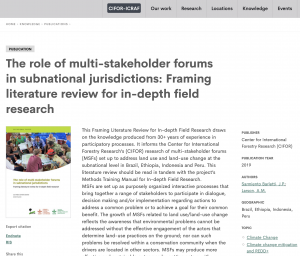
The role of multi-stakeholder forums in subnational jurisdictions: Framing literature review for in-depth field research
Drawing on 30+ years of experience, this Literature Review informs CIFOR's research on multi-stakeholder forums addressing land use in Brazil, Ethiopia, Indonesia, and Peru. It explores the potential of MSFs to coordinate goals effectively while cautioning against token participation and aims to contribute to the study of participatory processes in the context of climate change.
Trust building in a multi-stakeholder forum in Jambi, Indonesia
Liswanti et al. examine trust in multi-stakeholder forums (MSFs) through a literature review and Q-methodology analysis, finding that effective cooperation, unbiased facilitation, and a shared vision foster trust and contribute to the success of MSFs.
Trust-building and leadership in multi-stakeholder forums: Lessons from Indonesia
This paper investigates the impact of trust and leadership in multi-stakeholder forums (MSFs) addressing land and resource use in Indonesia. Conflicting interests can hinder trust-building, requiring an understanding of historical relationships to improve collaboration. Different challenges within MSFs call for specific leadership styles, including shared leadership for positive relationships and charismatic leadership for conflicts of interest or lack of trust.
The meeting of multiple governmentalities and technologies of participation in protected areas: The case of the Amarakaeri Communal Reserve (Peruvian Amazon)
This article analyzes the co-management of the Amarakaeri Communal Reserve (RCA) in the Peruvian Amazon, highlighting the intersection of socio-historical processes and the exclusion of Andean migrants from participatory governance. It raises questions about the inclusivity of multi-stakeholder forums in protected area governance.
The costs of elite-oriented multi-stakeholder forums to address deforestation: the case of the Green Municipalities Program in the Brazilian Amazon
This article examines the Green Municipalities Program (PMV) in Pará state, Brazil, a multi-stakeholder forum aimed at combating deforestation. Through qualitative analysis of in-depth interviews, it critiques the program's strategy of collaborating with powerful sectors while excluding indigenous and grassroots organizations. The research highlights the limitations of "anti-politics" approaches that fail to address underlying causes of environmental problems and raises concerns about the legitimacy of initiatives perceived as unjust in unequal contexts.
The Forest and Farm Facility (FFF) approach: delivering climate-resilient landscapes and improved livelihoods
This working paper highlights the Forest and Farm Facility's strategies and practical approaches in supporting FFPOs for climate-resilient landscapes and improved livelihoods. It emphasizes the potential of participatory, bottom-up approaches as nature-based solutions for people and the planet.
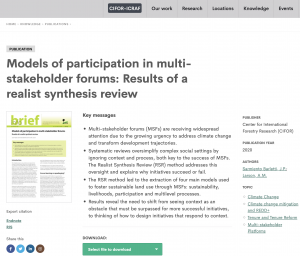
Models of participation in multi-stakeholder forums: Results of a realist synthesis review
Context and process are both vital for a MSF to succeed, but at times they can be ignored. This review shows that the more successful MSFs view context not as an obstacle, but instead design their initiatives to respond to it.
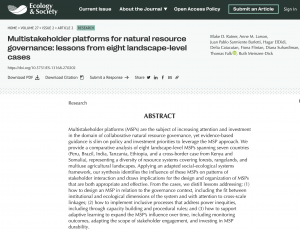
Multistakeholder platforms for natural resource governance: lessons from eight landscape-level cases
A comparative analysis of eight landscape-level multistakeholder platforms (MSPs) across seven countries, examining their influence on stakeholder interactions and offering insights for effective MSP design and organization. Lessons learned include the importance of aligning MSPs with the governance context, promoting inclusive processes to address power inequities, and supporting adaptive learning for long-term impact through outcome monitoring, expanded stakeholder engagement, and investment in MSP durability.

FUNDING PARTNER

PARTNER

Quick links
General enquiries
Niclas Gottmann
Niclas.GOTTMANN@ec.europa.eu
Kim Geheb
k.geheb@cifor-icraf.org