


Category: Publications and papers


Multi-stakeholder platforms for cross-border biodiversity conservation and landscape governance in East Africa: Perspectives and outlook
This working paper explores multi-stakeholder platforms (MSPs) for biodiversity conservation in East Africa. It assesses challenges, success factors, and the need for research on governance and monitoring. MSPs are crucial for managing biodiversity across sectors but require institutional linkages, skilled facilitation, science-policy connections, and sustainable financing.
Seeking synergies to improve landscape management in southern Zambia
Short blog by our CIFOR colleagues on COLANDS and a 9 step approach for Theory of Change and common visioning - in Zambia.
Designing for engagement: Insights for more equitable and resilient multi-stakeholder forums
A literature review that looks closely at the importance of engagement, allowing all actors to build trust and respect to ensure an approach that can lead to equitable outcomes.
The politics of river basin organizations: institutional design choices, coalitions, and consequences
This paper looks at all aspects of river basin organisations (RBOs), including the inevitable political debates during their formation, and examines lessons learned to make RBOs more effective in the future.
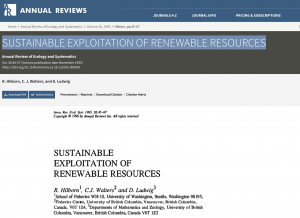
Sustainable Exploitation of Renewable Resources
This paper examines the huge number of variables involved in achieving the maximum potential yield in a sustainable manner, and looks at why it is often small-scale community or privately owned institutions that are the most successful at doing it.
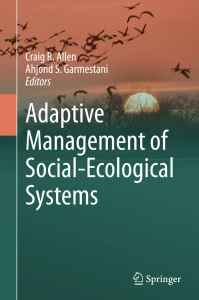
Adaptive Management of Social-Ecological Systems
This book examines all aspects of adaptive management including the history, theory, and its use in practice that allows stakeholders to modify plans to move forward.
Agroecosystem analysis
A systems analysis approach looking at agrosystems and how to ensure true multidisciplinary ways of working together. It concludes with questions for further research.
The Role of Multistakeholder Platforms in Environmental Governance: Analyzing Stakeholder Perceptions in Kalomo District, Zambia, Using Q-Method
This empirical study in Zambia's Kalomo District examines stakeholder perceptions of multistakeholder platforms (MSPs) in addressing landscape challenges within a dual land tenure system. Using Q-methodology, the study identifies three narratives: MSPs as fostering dialogue, emphasizing the role of government and private sector, or addressing power imbalances. While the narratives differ, there is consensus on the potential of MSPs to harmonise policies and promote dialogue to tackle landscape challenges.
A Knowledge Review on Integrated Landscape Approaches
Holistic and multi-transdisciplinary approaches, where multiple goals are achieved in order to improve resilience in societies and ecosystems in the short, medium, and long term, are ideal, even utopian. Hence, science has come together with practical experiences that highlight the importance of working at a ‘landscape’ level.
Using Scenario Building and Participatory Mapping to Negotiate Conservation-Development Trade-Offs in Northern Ghana
In multifunctional landscapes, expanding economic activities jeopardise the integrity of biodiverse ecosystems, generating conservation-development trade-offs that require multi-stakeholder dialogue and tools to negotiate conflicting objectives. Despite the rich literature on participatory mapping and other tools to reveal different stakeholder perspectives, there is limited evidence on the application of such tools in landscape-scale negotiations.

FUNDING PARTNER

PARTNER

Quick links
General enquiries
Niclas Gottmann
Niclas.GOTTMANN@ec.europa.eu
Kim Geheb
k.geheb@cifor-icraf.org