


Introducing landscapes
We define ‘landscapes’ as complex systems whose elements – social, ecological, political, economic – are entangled and co-produced. Their areas are defined depending on scope, and their condition is produced by the power configurations and regulatory dynamics operating within and upon them. Landscapes have heading – a trajectory produced by current patterns of practice and regulation. All of these various concepts will be discussed later in the Playbook.
When we speak of ‘scope’ this refers to your intent in the landscape. ‘Landscapes’ can be defined in a wide variety of ways: ecosystems, biomes, administrative boundaries, soil type, land use, agroecosystem, etc.
Ecological and social elements within a landscape system are entangled – not two separate domains in a relationship but co-constituted aspects of the same complex system. That said, it is not ecology that is driving its own degradation. The regulatory dynamics that shape landscape condition are overwhelmingly human: it is human practices, power configurations, and institutional arrangements that determine system heading. Our focus, therefore, is on the human drivers of ecological change – the power and regulation that dominate system patterning. Shifting these power configurations inevitably creates winners and losers [See Trade-offs]
Landscapes are produced. We are concerned with how specific actors and power configurations have ‘made’ landscapes – not ‘humanity’ in the abstract, but particular constellations of power accumulators and sharers whose practices shape landscape condition. Changing who produces the landscape means changing who benefits and who bears costs – again, trade-offs. The global discussion on the Anthropocene references the human production of the earth’s surface. Across all geographic extents, people have for centuries modified, tilled, worked, and reshaped the landscapes upon which they live or govern. The power vista (see Integration section) makes this concrete: a landscape’s condition is produced by the overlapping regulatory effects of actors with different geographic reach and different stakes in the landscape.
We find it useful to regard landscape as vista – a way of seeing how system’s elements interact, how its regulatory dynamics produce patterns, and where its heading points. The vista is not a view from outside: we are embedded within the system we observe, and our observation is itself a practice that shapes what we see. Nevertheless, the landscape as vista helps us perceive how the system functions as a whole.
Our landscape model
To help you think about ILM, we propose a three-layered model of what a landscape comprises: the landscape as a complex system, with its emergent behaviour. Embedded inside of this is power, inside of which are embedded practices. These layers interact – they are not mutually independent. Thus, practices pattern, regulate and shape power and its many different articulations, while power does the same to systems. Similarly, systems produce, emerge and constitute power, which then does the same to practices. Whichever variable it is that influences the layer it ‘bleeds’ into the surrounding layer.
It is important to note that, as a model, this is a representation of how reality is structured. In the landscape, things are far more dynamic. The landscape never stays still. But if you maintain your overview of the system vista, keeping an eye on each of these layers, you pave the way to a successful ILM intervention.
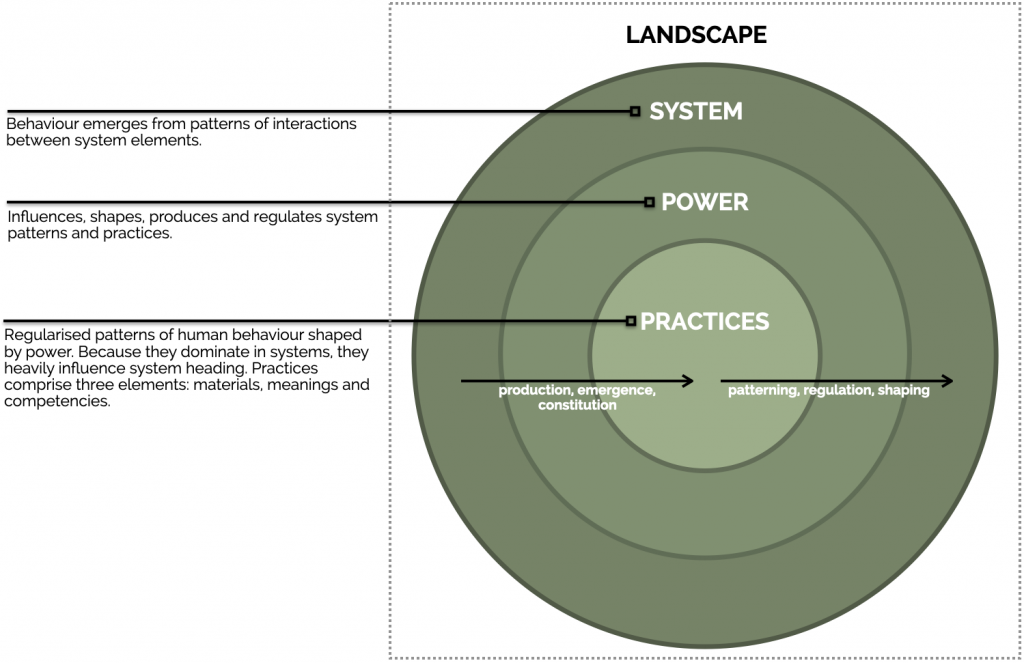
A crucial implication of this model is that the practitioner’s task is not to change what people do directly, but to change the conditions under which they act. In a complex system[GK2] , behaviour is generated by context – by the regulatory environment of power relations, institutional arrangements, and norms within which people operate – rather than mandated by instruction. ‘Regulation’ is how context is constituted: it is the dense web of pressures that together determine what is possible, permissible, and rewarded in a given setting. When we speak of intervening in the regulatory architecture, we are therefore speaking of reshaping the lived context that generates people’s everyday behaviour. This is what makes the landscape itself so important as a unit of analysis: the landscape is the context within which practices emerge.
Defining ILM
ILM is an intervention approach in complex landscape systems that influences power and practices to shift heading in integrated social-ecological directions.
The ILM practitioner reads the landscape through its power configurations, practices, and system dynamics to identify opportunity points where influence can shift its heading.
How this may be done is the focus of this Playbook.