


Governance
Governance is one of the most used and least understood words in natural resource management. It is routinely conflated with government, treated as something that can be designed, and assessed as ‘good’ or ‘bad’.
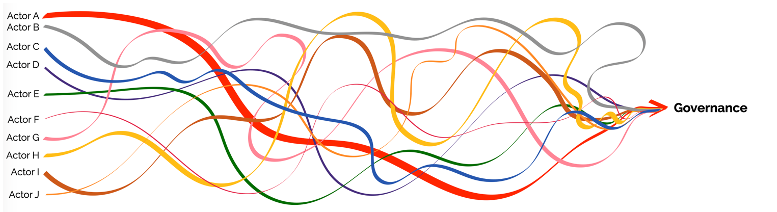
We take a different view. In a complex system, governance is not an input variable that can be dialled up or down. It is an emergent property of the system — a pattern that arises from the interactions of multiple agents, each pursuing their own interests, constrained by their own institutions, and operating with imperfect information. For us, governance is the outcome of how society shares power, benefits and risk. The shift from process to outcome matters. It positions governance as something that results from actor interactions, not something that can be engineered independently of them (see graphic below). Like a flock’s flight pattern or a market’s price signal, governance emerges from below and feeds back from above.
Three things follow from this framing.
Governance is not the monopoly of government
Governments are organisations that provide inputs into a governance system, but they are not alone. Corporations, customary authorities, religious institutions, civil society and households all contribute. In many developing countries, government can be weak, distant or almost irrelevant at local level, and governance emerges primarily from non-state actors. The concept of polycentric governance captures this reality. Stephan et al. (2019) describe polycentricity as connoting multiple ‘centres of decision-making authority’ that are de jure independent or de facto autonomous. In such systems, rules, norms and strategies are formed, applied, interpreted and reformed across multiple overlapping arenas. Ostrom (1990; 2010) demonstrated that self-organised polycentric arrangements are often better adapted to local conditions than centralised control.
Governance is not an input variable
Conflating governance with management leads to a seductive error: that we can ‘improve governance’ by designing better rules or more inclusive processes. But if governance is emergent, it cannot be directly manipulated — only influenced by altering the interconnections between agents, or by changing the practices, power relations and institutions through which those agents interact. ‘Governance reform’ is therefore not a technical exercise but a systemic intervention that must work through the same opportunity points that shape the system’s heading more broadly.
Governance requires focus on human behaviour
There is a strong inclination in natural resources management to forefront ecosystem impacts: deforestation rates, water quality, species loss. These are important, for they reveal consequences. But knowing that a forest is being cleared does not yield its conservation. It is necessary to focus on the human drivers — the practices, incentives, power structures and institutional arrangements that make deforestation rational for the agents involved. We therefore prioritise human behaviours in our understanding of governance.
Finally, there is no objectively ‘good’ or ‘bad’ governance. From any vantage point, outcomes may be desirable or undesirable, but the system does not care. This redirects attention from moralising about governance quality to understanding the configurations of power, practice and institutions that produce the outcomes we observe.
Institutions
If governance is the emergent pattern, institutions are a critical part of the infrastructure from which it emerges. North (1990) defined institutions as the ‘rules of the game in a society’ — the humanly devised constraints that shape human interaction. These include formal rules (laws, regulations, contracts) and informal constraints (norms, conventions, taboos). Ostrom (2005) extended this by distinguishing rules-in-form from rules-in-use: the written rule may say one thing, but the operative institution is the one that is practised and enforced in daily life.
In the vocabulary of this Playbook, institutions one major source of regulation. They constrain some behaviours and enable others: who can access a resource, who decides about its use, what sanctions apply, how disputes are resolved. A grazing institution that allocates dry-season pasture among clans regulates where livestock move, when and in what numbers. Institutions are power made structural — they encode historical settlements about who gets what and whose interests count.
Institutions also represent a potent opportunity point. Because they pattern practices, changing an institution can cascade through the practice configurations it sustains. New land tenure rules can shift grazing practices, alter power relations, and change a landscape’s ecological trajectory. But institutions are nested, overlapping and often contradictory. Formal law may say one thing while customary practice does another. Institutional change is not a technical fix but a perturbation whose effects may or may not unfold as intended.
Critically, institutions are not only formal. The norms governing how much firewood a woman may gather, or the unspoken rules about who speaks at a community meeting, are institutional in exactly the same sense as a national forestry law. In many landscape contexts, these informal institutions are the dominant regulatory force. Interventions that ignore them will encounter the snap-back effects discussed elsewhere: the system’s informal institutional infrastructure resists and returns practices to their prior configuration.
To summarise: institutions regulate practices; in doing so, they express and reproduce power relations; the aggregate effect of multiple institutions, operating across multiple agents, produces governance as an emergent outcome. Institutions sit at the junction of power and practice in our layered model — they are where regulation becomes tangible.
References and further reading
Cosens, B.A., Ruhl, J.B., Soininen, N. and Similä, J. 2021. Governing complexity. PNAS 118(36), e2102798118, https://doi.org/10.1073/pnas.2102798118.
Folke, C., Hahn, T., Olsson, P. and Norberg, J. 2005. Adaptive governance of social-ecological systems. Ann. Rev. Environ. Resour. 30(1): 441–473, https://doi.org/ 10.1146/annurev.energy.30.050504.144511.
North, D.C. 1990. Institutions, institutional change and economic performance. Cambridge: Cambridge University Press.
Ostrom, E. 1990. Governing the commons: the evolution of institutions for collective action. Cambridge: Cambridge University Press.
Ostrom, E. 2005. Understanding institutional diversity. Princeton (NJ): Princeton University Press.
Ostrom, E. 2010. Polycentric systems for coping with collective action and global environmental change. Global Environ. Change 20(4): 550–557, https://doi.org/10.1016/j.gloenvcha.2010.07.004.
Schlüter, M., Haider, L.J., Lade, S.J. et al. 2019. Capturing emergent phenomena in social-ecological systems: an analytical framework. Ecology and Society 24(3):11 https://doi.org/10.5751/ES-11012-240311.
Stephan, M., Marshall, G.R. and McGinnis, M.D. 2019. An introduction to polycentricity and governance. In: Thiel, A., Blomquist, W.A. and Garrick, D.E. (eds) Governing complexity: analyzing and applying polycentricity. Cambridge: Cambridge University Press: 21–44.