The European Union’s Landscapes for Our Future programme supports 22 integrated landscape management projects across 19 countries and 3 sub-regions across the Global South.
Beyond the numbers: understanding how landscapes change
What shapes success in Integrated Landscape Management (ILM)? While quantitative analysis can help identify patterns, Kim Geheb argues that many of the factors that matter most – trust, relationships, local leadership and the ability to "read" a landscape – are often harder to measure, but no less important.
Kim Geheb
10/06/2026
Our forthcoming global synthesis paper is an important output from the Landscapes For Our Future (LFF) programme and one that we can be collectively proud of. It makes a genuine contribution by providing the first systematic, quantitative comparison of ILM performance across all of the various projects and landscapes within the LFF portfolio.
And don’t underestimate the challenge of doing this: we’ve had our 22 projects, enormous geographical distribution across the tropics, different teams, different institutions, and so forth. So being able to capture that diversity and then sort of constrain it, if you like, is a significant challenge and one which I think the paper has done really well to address.
What I’ve been reflecting on, though, is how the research sits within the broader body of learning emerging from our programme. The paper looks at which conditions correlate with stronger outcomes across the landscapes that were studied in a particular moment in time. What it does not seek to explain is how those conditions came into being, and the kinds of work that created them or how they might be shifted over time. For me, that is where some of the other work emerging from Landscapes For Our Future becomes important.
The challenge is that many of the things practitioners spend their time doing are inherently difficult to measure. There is a quotation I often return to: “Not everything that can be counted counts and not everything that counts can be counted.”11
When we visit landscapes, we encounter things that do not fit neatly into indicators and datasets: the patient cultivation of trust over years, the relationships between project teams and communities, the way conflict is navigated, the role of local knowledge, and the ability to recognize opportunities that outsiders might miss. These dimensions are often critical to how landscapes function and evolve.
In fact, I would go further. What lies outside the measurable indicators is often not simply background noise. In many landscapes, it is the signal. This is one of the reasons why the soon-to-be published ILM Playbook places so much emphasis on learning to read landscapes. When we talk about institutions, for example, we often think immediately about government. Yet many landscapes are also shaped by less visible institutions – the local rules, norms, relationships and governance arrangements that communities have developed over time.
These are often easy to overlook, particularly for outsiders.
Very often, when we arrive in a landscape, we are introduced to the official authority structure. But if we spend enough time listening and observing, we begin to notice other forms of influence and leadership. We discover people who hold no formal authority but whose opinions carry enormous weight. We begin to understand relationships, histories and power dynamics that are not immediately visible.
For me, governance is not simply a condition that exists before an intervention begins. Governance is an outcome of power dynamics. It’s not a stable background condition.
The question is not whether a landscape possesses ideal governance conditions when we arrive. The question is how practitioners can work with the realities they encounter.
So, more than merely “what does governance look like at this moment in the landscape?” it’s about “how do we shift it in such a way that it will improve the chances of ILM success?” Practitioners who are able to do this well are often working with things that are difficult to quantify. They are building relationships, understanding incentives, recognizing local leadership and helping people work together in new ways. They begin working with the power to try to shift it in particular directions that will then establish the groundwork for successful ILM.
Ultimately, though, successful ILM is not the goal.
Landscapes matter because they are places where social, economic and environmental pressures come together. We turn to Integrated Landscape Management because we believe it offers a way to address those pressures more effectively.
As I often say, the landscape is a scale. The integration is the method. The purpose is not integration for its own sake. The purpose is to help landscapes move in more sustainable directions. And the global synthesis paper provides an important perspective on that challenge. But it is one perspective among many.
As a programme, we have also produced case studies, practitioner reflections, learning missions and the forthcoming ILM Playbook. Together, these help us understand not only the patterns we can measure, but also the relationships, processes and human realities that produce those patterns. For me, there’s a very rich picture emerging from the programme as a whole, and the paper is a key part.
You might also be interested in…
Our global synthesis: what really makes ILM work? Why do some landscape initiatives gain momentum while others struggle to endure? In this preview of a forthcoming paper, George Schoneveld reflects on lessons from 15 landscapes and the factors that seem to make the biggest difference.
Khalil Walji points out that reading the landscape does not replace measurement; rather, it provides the contextual understanding needed to interpret what the indicators are telling us. ↩︎
When the land bears scars: Violence and memory in Papua New Guinea
Can Integrated Landscape Management be a vehicle for peace? On a repeat visit to PNG, Kim Geheb contemplates the physical landscape scarred by violence, and the cultural and social landscapes that gave rise to this – but which might also be fertile grounds for the seeds of change.
Enga Province in the central Highland Region of PNG is a heavily forested part of the world and supports an astonishing biodiversity. Enga is also unusual in PNG for its cultural homogeneity. The Enga are a highland horticultural society that makes up the largest linguistic group in the country. They are divided into nine mutually intelligible dialect groups (‘clans’) that, besides language, share important economic, social, political, and religious orientations.
These clans are tight. The social capital of Enga province is immense. But this can also lead to problems. As one of my colleagues here put it, “When you attack one [clan member], you attack us all. Even if I do not agree with your perspective, I will come to fight alongside you.” And that’s the thing. The Engans fight a lot – despite their common ancestry, and the similarities in language and culture across all clans. So much so that “in Enga historical traditions there is no ‘time before warfare’.”1 This is because
Engas conceive of fights not as problems (or crimes) but as a solution to other problems and not as threats to order but attempts to restore order.”2
Early in 2023, a few months prior to my arrival, there had been an attack at a funeral in Enga. It was said that a man had been found floating dead in Lai River, which runs through the provincial capital, Wabag. In turn, the dead man’s clan blamed his wife, her clan, and possibly her lover.3 So, during the dead man’s funeral, his clansmen attacked those from the wife’s clan with machetes and axes. Five died.
In the months following, revenge attacks picked up, back and forth between the clans. Soon other clans joined in. Police or army were apparently unable to stop it, because – my colleagues told me – they are outgunned by the Engan warriors. “They can only sit by and watch. When it’s over, they go in and collect the bodies.” Soon, more clans became involved, and many villages were raided and burnt down.
When I landed in Mount Hagen in 2023, the UNDP team was there to meet me in a Land Cruiser with caging over the windows and windscreen, and a police escort. It was twilight as we neared Wabag and everyone in the car was edgy. We were approaching a spot where an attack had just occurred. In the car’s headlights, I could see charred tree-stumps and the rubble of houses along the road. My colleagues explained how ‘they’ came, and ‘they’ attacked. They butchered the men, stole the pigs, and sent the women and children fleeing. Once there was no one left to kill and no houses left to burn, the attackers turned their attention to destroying the land so that those who had fled would never come back. They ring-barked hundreds of trees.
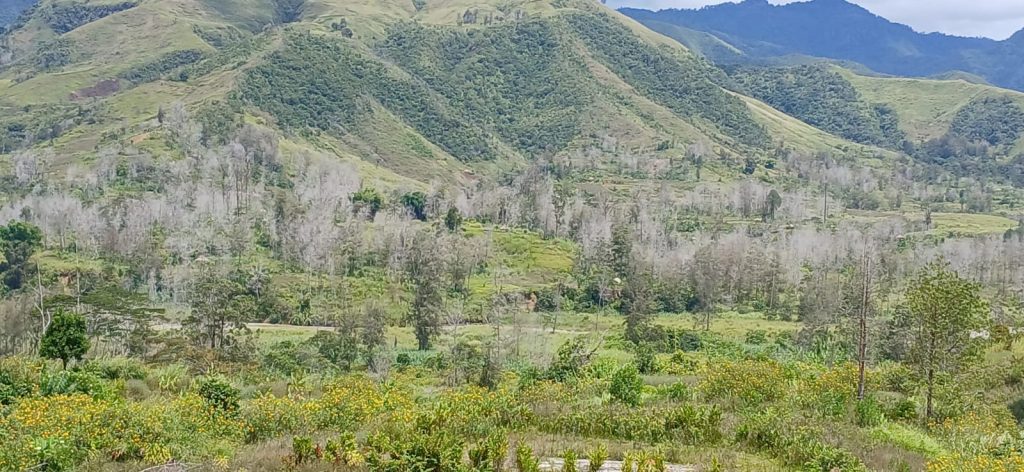
When I returned in 2025 (this time with Khalil Walji), we followed the same route down to Wabag. In Wapenamanda District, we stopped to look out across a largely uninhabited landscape. No farms, no hamlets, no bustle. Between us and the distant range of hills was the strip of ring-barked trees – a wide swath that ran for kilometre after kilometre. Landscape as weapon.
The reasons for Engan fights often start small. “The vast majority of Enga wars were, and are still, fought between neighbouring clans over conflicts that begin with a brawl and escalate.”4
“All things happen because of the tongue, the uncontrollable tongue that ought not to have said certain things that were said.”
In the past, men fought over hunting rights, sharing of game meat, insult, and injury. Most fights ended with clans splitting to settle in unoccupied areas of clan land or neighbours departing to join relatives in distant areas.6 But the past also offered means of redress, with rules of warfare being established and peace-making coming to be seen as a means the limiting the enormous costs of war.
But the advent of modern weaponry changed everything. A new class of fighter emerged: the ‘hireman’ or ‘Rambo.’ Rambos are experts in wielding modern guns, and are hired by clans in exchange for money, pigs and sexual access to women.4 Clan elders, Polly Wiessner tells us, “lost control over war to these avid modern fighters” who would lead clansmen into battle anywhere and for trifling reasons. At the same time, however, the churches got involved, as did an initiative called ‘Operation Mekim Save,’ which spawned dozens of village court mediators and contributed significantly to peacebuilding. In any case, the public were tired of Rambo bravado, the deaths and destruction. Fighters hoping for tribal accolades were, by around 2010, getting very few.
With peace building in Enga, no matter when in history, compensation or reparations are a key factor – for example, a pair of warring clans compensating each other for men killed in a previous battle. Young men will come to the aid of allied clans during times of war – an act they expect to be compensated for. If they are killed, the clan who received their support is expected to pay even more compensation. Because compensation is required in so many scenarios, “there is so much compensation to be paid that the next generation will still be covering the debts of the present one.”4
This heavy debt has entered into politics – wealthy businessmen may try to gain repute by contributing to the payment of debt; and so too politicians looking to gain votes. The entrance of the state has also coloured conflicts, with clans provoking fights in support of favoured candidates. “The thrust of Engan history is clearly that it is not the case that a weak state struggles to govern a strong society in Enga. Rather, the state was a prize over which a society of clans competed.”2
So, while incidences of violent conflict began tapering off at the end of the oughts, their tempo now appears, once again, to be increasing. The 2022 General Election was, in Enga, chaotic and violent. In 2024, at Sat Akom, an attack occurred, emerging out of a tit-for-tat feud amongst the Sikin, Ambulin and Kaekin clans. The Ambulin clan, anticipating an attack, ambushed teams led by hiremen, leading to the death of 50 (maybe more) alleged hired gunmen from the Sikin and Kaekin clans.
After a day of workshopping, Khalil Walji and I walked into the bar of the Wabag Hotel where we were staying. One of the patrons, it turned out, was the Governor of Enga Province, Sir Peter Ipatas. Curious about what we were up to, he invited me to sit down with him for a chat. I asked him why Engans fought. It was, he said, because Engans are caught in between a deeply traditional and powerful culture, and the modern world pressing in. The province’s children go to school, and when they emerge (or drop out), there is nothing for them to do. Tradition cannot take them back, and modernity isn’t in a position to invite them in.
This compression between tradition and modernity led, he argued, to fighting. Young men have nothing to do, and when a conflict starts, they rush to it, because they have nothing better to do. Injustices are talked up, and when one member of a clan feels that he’s been wronged, then, as I quoted above, an attack on one is an attack on all.
During the workshop we ran with UNDP, we held a stakeholders’ event. The UNDP invited most of its grantees – representatives from community organisations that had received small grants from SISLAM – to carry out land use change and implement sustainable farming practices that catered to biodiversity conservation and climate-smart agriculture. At the event, we had maybe ten – very welcome – participants. The rest were off attending the funeral of a man who had been murdered, gunned down in his car along the Highlands Highway. On the way down to Wabag, we had passed the burned-out shell of his car. Peacekeeping had kicked in. The attackers’ clan had accepted that it was a case of mistaken identity, and the killers were now in a cell at the Wabag police station.
In the second row back was a very quiet man. I had met him the first time I was here. Jacky Yalanda is a former hireman. “He killed 40, maybe 60 people,” a colleague whispers to me. Now he works for the PNG Forestry Department, which, with SISLAM’s support, is planting 100,000 trees in the Kenda Valley, where fighting has depopulated the land, and former farming areas are going to seed.
In the bigger scope of Enga’s violence, Mr Yalanda is a small – if significant – turnaround. I’m sold by his quiet passion, for sure. It hints at an idea that the SISLAM team has been playing around with:
Perhaps Integrated Landscape Management could play a role in bringing peace to Enga?
There are several reasons why they – and we – have been debating this concept.
The first goes back to what Sir Ipatas had said – that there’s nothing for young men to do. It matters little if the province can provide its children with free education (which Enga has managed to do) if there are no jobs for them to move into. And so they have nothing to do. You can see it in Wabag. Young, bearded men in military-style clothing stand around everywhere, smoking and chewing betel nut, waiting for something to come along or to happen.“The devil” as Thoreau noted, “finds work for idle hands.”
The second reason is that giving communities a focus from which they directly stand to benefit – in ways that they they understand – has completely transformed life in the communities that received grants. These are not large grants by Western standards – anywhere between 45 and 90,000 Kina (roughly US$11,250-22,500). This isn’t just because they now have some cash; but they have cash to do something with, supported by SISLAM.
Another aspect to all of this that I grew acutely aware of when I visited sites in 2023 was that when the UNDP Land Cruiser came up the track, these communities were absolutely delighted to see them – not because it was UNDP, but because they had someone to show off to: more trees saved from felling, more square metres under sweet potatoes, more healthy pigs in their sties. I’ve visited many of the LFF’s 22 projects, and I’d never encountered such spirit amongst beneficiaries. Grant recipients were on fire – with enthusiasm, desire to learn, and desire to change.
The third reason is that Enga has pretty much everything it already needs, both to implement ILM and to use it as a way to achieve peace. There’s land aplenty, massive forests (over 90% of the province is forested), staggering biodiversity and, perhaps most importantly, strong and powerful social institutions that need not serve violence but can, instead, be turned inwards in the service of livelihoods and peace. The evolution of Engan cultural and social institutions have been turned towards peace in the past – they are capable of adaptation. Presently, however, I feel like they have been so weakened that they’ll need support if they are to get back to a place where they can support the governance of this remarkable landscape.
Fourth, there is precedent. Every time I’ve visited Enga, I have thought about the Salween Peace Park, an initiative being implemented by the Karen Environmental and Social Action Network (KESAN) in eastern Myanmar. The Karen are a proud people, and the park is their rebuttal to the intentions (usually violent) of the country’s military junta. To be sure, Enga’s violence comes from within, while that of the Karen comes from without. But, inwardly, the park draws on Karen social and environmental institutions to manage their land in ways that approximate how they have done so for generations. The Peace Park is not a protected area in the sense that only those who can afford to do so get in. Rather, people and environment are blended within it, recognising that one reinforces the other. It has a charter, co-created with the landscape’s communities, which in turn frames the landscape and provides the guard-rails within which its occupants operate. Myanmar’s military junta is a difficult army to push back, but I admire what KESAN and the Karen National Union have attempted here: a quiet middle finger to the regime – the offer of our peace to your violence. The Engans have no such external aggressor – they can control their own violence, provided the will, institutions and support are there.
And finally, there are pre-existing frameworks to build upon – that of Operation Mekim Save, the province’s churches, and any number of other initiatives that have sought to enable, structure and deliver peace. But if we take these processes several steps further back, to focus on the drivers of violence – the lack of opportunity, the lack of purpose, the lack of anything to do – then ILM becomes a high potency vehicle for change and peace.
Notes on an exhibit at the Take Anda Museum in Wabag, Enga Province. ↩︎
Golub, A. 2021. Restraint without control: law and order in Porgera and Enga Province, 1950–2015. In Bainton, N. and Skrzypek, E.E. (eds) The absent presence of the state in large-scale resource extraction projects. Asia-Pacific Environment Monograph 15. Canberra: ANU Press. ↩︎
There are many variants of this story. The one I produce here resembles that published in Swanston, T. and Gunga, T. 2023. Tribal fighting in PNG’s highlands has escalated into guerilla warfare, leaving desperate villagers with nowhere to go. ABC News 12 September 2023: https://www.abc.net.au/news/2023-09-12/png-tribal-violence-enga-escalates-into-guerilla-warfare/102826764 ↩︎
Wiessner, P. 2010. Youth, elders, and the wages of war in Enga Province, Papua New Guinea. State, Society in Melanesia Discussion Paper 2010/3.Canberra: The Australian National University: School of International, Political and Strategic Studies: https://openresearch-repository.anu.edu.au/handle/1885/9889. ↩︎
Quoted in an exhibit in the Take Anda Museum, Wabag ↩︎
Wiessner, P. 2019. Collective action for war and for peace: a case study among the Enga of Papua New Guinea. Current Anthropology 60(2): 224-244, https://doi.org/10.1086/702414. ↩︎
We value your privacy
To provide the best experiences, we use technologies like cookies to store and/or access device information. Consenting to these technologies will allow us to process data such as browsing behavior or unique IDs on this site. Not consenting or withdrawing consent, may adversely affect certain features and functions.
Functional
Always active
The technical storage or access is strictly necessary for the legitimate purpose of enabling the use of a specific service explicitly requested by the subscriber or user, or for the sole purpose of carrying out the transmission of a communication over an electronic communications network.
Preferences
The technical storage or access is necessary for the legitimate purpose of storing preferences that are not requested by the subscriber or user.
Statistics
The technical storage or access that is used exclusively for statistical purposes.The technical storage or access that is used exclusively for anonymous statistical purposes. Without a subpoena, voluntary compliance on the part of your Internet Service Provider, or additional records from a third party, information stored or retrieved for this purpose alone cannot usually be used to identify you.
Marketing
The technical storage or access is required to create user profiles to send advertising, or to track the user on a website or across several websites for similar marketing purposes.
This website uses cookies to improve your experience and help us analyse our traffic. By clicking "Accept", you consent to our use of cookies. Privacy notice
Functional
Always active
The technical storage or access is strictly necessary for the legitimate purpose of enabling the use of a specific service explicitly requested by the subscriber or user, or for the sole purpose of carrying out the transmission of a communication over an electronic communications network.
Preferences
The technical storage or access is necessary for the legitimate purpose of storing preferences that are not requested by the subscriber or user.
Statistics
The technical storage or access that is used exclusively for statistical purposes.The technical storage or access that is used exclusively for anonymous statistical purposes. Without a subpoena, voluntary compliance on the part of your Internet Service Provider, or additional records from a third party, information stored or retrieved for this purpose alone cannot usually be used to identify you.
Marketing
The technical storage or access is required to create user profiles to send advertising, or to track the user on a website or across several websites for similar marketing purposes.


 Kim Geheb