Communities at the heart of conservation: Lessons from Laos

In the rugged landscapes of northern Laos, conservation is not only about protecting forests and wildlife within park boundaries. It is about forging, maintaining and deepening partnerships with the people who live in and around those landscapes.

For WCS Laos, the lead implementor on the Ecosystem conservation through integrated landscape management in Lao People’s Democratic Republic (ECILL) project, stakeholder engagement has proven to be the decisive factor in whether conservation efforts succeed or fail.

In the video below, Ben Swanepoel, a programme leader with WCS, gives us some insight into exactly what that looks like on the ground.

The communities themselves are going to be creating the success or failure of the protected area — not our good deeds inside the protected area.

Ben Swanepoel, a programme leader with WCS

From fragmented programmes to integration

WCS Laos has not always worked this way. Ben recalls earlier years when efforts were split into separate programmes: one focused on law enforcement, another on outreach, and still others on ecotourism. Each had merit, but their impact was limited.

“They had marginal success,” he reflects. “The only time we can actually demonstrate a genuine success — something we can measure — is when we put all of this together.”

This insight has led to a new way of working. Now, conservation agreements are accompanied by multiple, interconnected teams: monitoring, livelihood development, stakeholder engagement, land-use planning, and integrated management. Together, they form a comprehensive strategy that addresses the complexity of the landscape.

Ben is convinced: “Integrated is just the right approach for a protected area like this.”

Shifting the balance of responsibility

What makes this integrated approach particularly powerful in Laos is the shift in who drives conservation success. In some contexts, conservation has been about fencing off land and keeping people out. In Ben’s experience, such models are not only unrealistic but counterproductive.

In contrast, the Laos project demonstrates that when communities are given a genuine stake in conservation — backed by economic opportunities, clear agreements, and accountability mechanisms — they become the decisive actors.

“It’s completely the other way around,” Ben says. “NEPL MU are actually going to the community and saying: how can we involve you in the conservation here? It’s the communities themselves that are going to create success.”

Coffee as a catalyst for change

One of the most striking examples comes from an initiative with five villages bordering a protected area. As part of the Ecosystem conservation through integrated landscape management in Lao People’s Democratic Republic (ECILL) project, with the leadership of the Nam Et–Phou Louey Management Unit (NEPL MU), WCS and its partners worked with 80 households to introduce coffee as a viable livelihood alternative. Coffee offered much higher returns and, importantly, it was linked directly to conservation agreements.

Households signing up to grow coffee also committed to refraining from hunting and other unsustainable activities. These agreements came with clear monitoring systems and penalties, ensuring accountability while offering tangible benefits.

“By doing that,” Ben explains, “the NEPL MU has signed conservation agreements. Everybody who wanted to do coffee has signed up, because they know they’ll earn more from this. And in return, they agree to stop hunting.”

This approach shows how carefully designed livelihood interventions can align community wellbeing with conservation objectives, creating a win–win scenario.

Lessons for Integrated Landscape Management

The experience in Laos offers valuable lessons for other projects in the Landscapes For Our Future programme and beyond:

  • Livelihoods as leverage: Alternative income opportunities must be meaningful and profitable enough to motivate change. Coffee, in this case, provided a clear pathway.
  • Agreements with accountability: Conservation commitments tied to real incentives — and backed by monitoring — strengthen trust while ensuring compliance.
  • Integration over fragmentation: Conservation gains are maximised when law enforcement, outreach, livelihoods, and land-use planning are part of a single, coherent strategy.
  • Communities as co-managers: True success comes when local people are not peripheral, but central, to the design and delivery of conservation outcomes.

These insights reinforce a central principle of integrated landscape management: sustainable change cannot be achieved through isolated interventions. It requires collaboration, alignment, and above all, a recognition that landscapes belong to the people who live within them.

As the WCS Laos experience shows, when communities see both the benefits and the responsibilities of conservation, they step forward not as passive recipients but as active stewards of the landscape. And it is in their hands that the future of these protected areas will be secured.

Dialogue in disintegrated landscapes: insights on stakeholder engagement

One of the six core dimensions of Integrated Landscape Management (ILM), as articulated in our Central Component’s initial hypothesis, is stakeholder engagement: inclusive, meaningful engagement of all those who shape or depend on a landscape is vital. But what does effective engagement look like in practice?

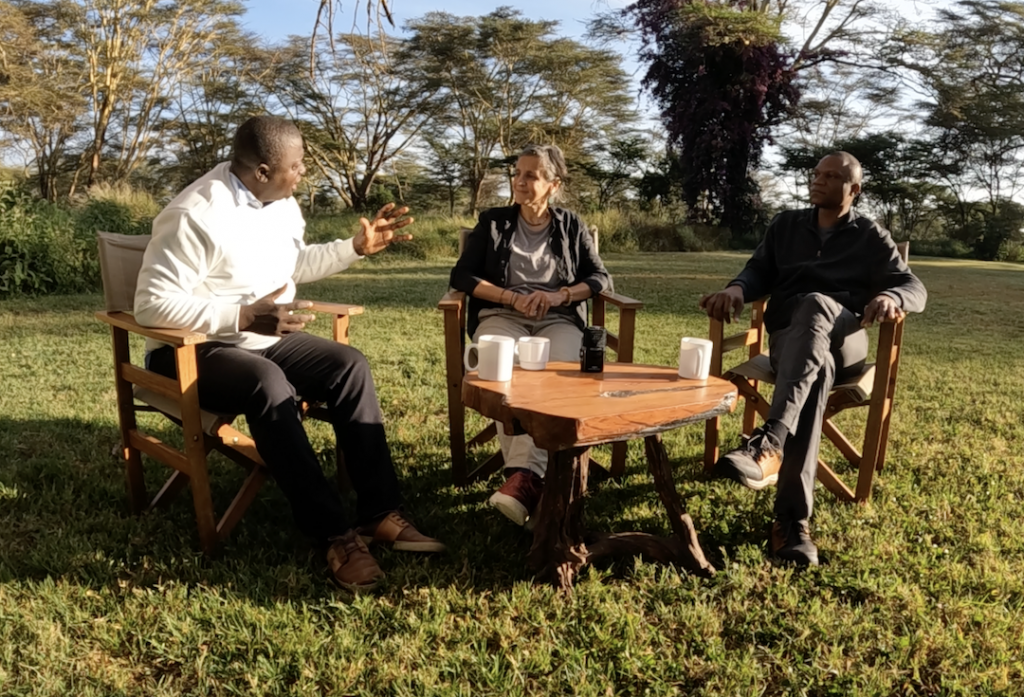
One sunny morning in Kenya, a lively discussion between Divine FoundjemValentina Robiglio and Raphael (Rapha) Tsanga – three of our regional focal points – brought to light some of the challenges and opportunities of engaging diverse, and sometimes conflicting, stakeholders across Africa and Latin America.

Through their conversation – and especially some of the provocative statements the three made – several pieces of advice emerged for those planning to implement future projects:

Listen in on the full conversation now, or skip to the highlights below.

Map roles, interests and power

The first step in stakeholder engagement is to map who the stakeholders are. Farmers, cooperatives, local leaders, government agencies, private companies, and donors – all bring different priorities. But identification alone is not enough.

You identify who the stakeholders are, but it does not stop there. You need to move a step further by identifying what their role is in that given landscape, why they are interested, and how much they can influence things positively or negatively.

– Divine Foundjem

Stakeholders may seek livelihoods, resources, political influence or conservation outcomes. Their power can be enabling or obstructive.

Divine pointed to North Cameroon as an example: “We have in the north the effect of Boko Haram. These actors stop development partners from going to the field because they may easily be kidnapped. Those are powerful actors – but can you bring them to the table?”

Go beyond representation

Stakeholder engagement risks becoming a “checklist exercise” – inviting one farmer, one woman, or one minority representative to tick a box.

They say, ‘Okay, farmers are represented. The minority groups are represented.” But it’s just a checklist. They don’t really care whether that category of persons has the decision-making power to say things that they really want to say.

– Divine Foundjem

Real inclusivity means active participation:

Less powerful groups need empowerment to speak and relay messages back to their communities. Rapha cited the example of including informal loggers: This inclusion is a long-term strategy. It is a process that requires tact and support. At first, these actors couldn’t even speak in front of the Director of Forests. As facilitators, we helped them build confidence, learn from others in the region, and engage in dialogue that led to changes in regulation.”

  • Less powerful groups need capacity-building to speak and to carry messages back to their communities.
  • More powerful actors need support to accept the participation of minorities and listen without feeling their authority is threatened.

As Valentina noted: “The important thing is that the powerful people have to listen. That is the most challenging – because sometimes they feel that by listening, they are losing their power.”

Balance law and legitimacy

Rapha reminded us that local realities often clash with formal law: “Most of the actors in the landscapes where we are working are local communities, operating informally in fishing, hunting or logging – and most of the time they are treated like criminals. In my perspective, they are not.”

He stressed the need to distinguish between legal, illegal, legitimate and illegitimate.

Sometimes the law doesn’t capture the local dynamic. Encroachment may be informal and illegal, but actually legitimate. That legitimacy organizes the way people intervene in the landscape.

– Rapha Tsanga

He cited an example of informal logging in the Congo Basin which illustrates how inclusion over time can shift dynamics: “For the government, informal logging was illegal. But we called it informal because we didn’t want to treat these actors as criminals. If they are not criminals, they can sit around the table, talk to the government, discuss regulations, and gradually operate legally.”

This nuance is crucial in designing multi-stakeholder fora where rules must balance conservation, livelihoods and legitimacy.

Acknowledge ‘difficult’ actors

What about groups that cannot be brought to the table – armed rebels, narco-traffickers, or criminal gangs?

“This is the elephant in the room,” Rapha said. “If we take them on board, we create conflict with the government. If we do not, we can’t implement ILM practices because they are the ones controlling the landscape.”

ILM projects can play a stabilizing role in violent conflict settings:

  • In Burkina Faso, projects created social centres where young people play football or watch films, helping build trust and exchange information about external threats.
  • In Colombia, initial stakeholder mapping omitted mention of armed groups – but facilitators used background knowledge to ensure their influence was acknowledged, even if they weren’t physically present.
  • In Central African Republic, projects have worked indirectly through humanitarian organizations and the UN.

As Rapha emphasized, “ILM cannot solve all the problems, but at least it can maintain a kind of balance. Without ILM, the situation would probably be worse.”

Create alternatives for youth

Armed groups and war economies often attract young people with the promise of money and influence. ILM projects must therefore create livelihood alternatives.

Sometimes it is easier for a young person to join an armed group. When you have a weapon, you can get money. The idea is to create alternative activities, income-generating projects, so that they don’t have to join.

– Rapha Tsanga

This requires coalitions of actors – governments, donors, civil society – complementing project-level initiatives.

Co-create a shared vision

ILM can support the creation of a shared vision.

It’s important that those who sit together in a platform to manage a landscape develop a common vision of where they want to go. People come first. Landscapes are about human beings.

– Divine Foundjem

This vision cannot be forged in a single meeting. It is a long-term process of negotiation, adaptation and trust-building – but one that is essential for resilience.

Recognize the agency of ILM practitioners

The conversation then turned to the practitioners themselves. They are not neutral observers; they are facilitators, brokers, and often the only actors trusted enough to mediate.

Rapha recalled the emergence of forest certification in the Congo Basin nearly two decades ago: “The government allocated logging concessions on the map, everything was fine on paper. But logging companies had to deal with local communities who were hunting and fishing in the concessions. One of the solutions was to put in place multi-stakeholder platforms to discuss rights, what was legal, what was forbidden, and to adapt strategies iteratively when problems arose.”

He stressed that ILM practitioners have a critical role in organizing such processes at the landscape level, while also recognizing when to bring in state officials who ultimately hold policymaking authority.

Valentina underscored the importance of trust: “It’s important for practitioners to build trust so that all stakeholders recognize their facilitating role and so can genuinely broker dialogue.”

When people trust that the process can lead to change, even if it takes time, they are willing to sit at the table.

– Valentina Robiglio

Divine expanded: “In contexts of weak governance, farmers often don’t trust government officials to mediate conflicts. They believe officials can be corrupted by richer actors. That is where we, as practitioners, have to come in – to facilitate trust building, to guarantee trust, to create spaces where actors can see for themselves what is right and wrong.

View multi-stakeholder platforms as processes, not events

Meetings are just one element in a much broader journey, as Valentina pointed out: “What’s important is to remember that multi-stakeholder platforms are not just about meetings. They are long-term processes – bilateral engagements, informal meetings, listening, and building enabling conditions. Meetings are just the visible tip of the iceberg.”

Rapha was clear about the proportion of effort required:

Ninety percent of the work is the invisible part – informal meetings, bilateral conversations, listening, understanding local dynamics. Only once that groundwork is done can you organize big meetings with nice pictures. Those are the visible end stage, but the real process is long, patient, invisible work.”

Rapha Tsanga

Invest in invisible work

Divine raised a challenge: “Donors often measure processes by the number of formal meetings held. But the groundwork – the informal meetings, negotiations, and mediation – is what really matters. It is resource-intensive, but it is what builds trust and makes change possible.”

Donors often complain about ‘transaction costs’. But really, transactions – the informal meetings, the shared meals, the building of trust and familiarity, the listening – are what results in successful ILM. Transaction costs shouldn’t be eschewed, but rather, invested in. High transaction costs are, in our view, an indicator of likely ILM success.”

Kim Geheb, Landscapes For Our Future Central Component Coordinator

Conclusion: stakeholder engagement is the backbone of ILM

Stakeholder engagement is not a technical step but the very backbone of Integrated Landscape Management. It requires patience, humility, courage and creativity – particularly in fragile and conflict-affected contexts.

As the examples from Cameroon, Burkina Faso, Colombia and the Congo Basin show, meaningful engagement not only builds governance but also contributes to peace, stability and resilience.

Through these insights, we’re continuing to refine and demonstrate ILM practice – showing that inclusive, negotiated and adaptive engagement is the path to sustainable and just landscapes.

Facilitating with respect: Lessons from Zimbabwe’s Lowveld

When Lemson Betha first arrived in Zimbabwe’s southeast Lowveld to work as a facilitator for SAT-WILD, he was stepping into unfamiliar territory: he hadn’t grown up in the region, and didn’t speak the local language. But he knew that building trust would be the foundation of any successful work.

Today, the Sustainable Integrated Landscape Management in the Gonarezhou National Park and surrounding communities project is regarded as one of the strongest role models amongst the 22 projects in the Landscapes For Our Future programme, not because SAT-WILD and the other project partners had all the answers from the start, but because they have remained committed to facilitation, co-creation, and adaptive learning. Lemson’s reflections below offer invaluable guidance for anyone working with communities on complex, long-term landscape challenges.

Learn directly from Lemson or read the summary below:


Begin with respect

For Lemson, the starting point is simple but powerful: treat communities as equals. “View them as people with the same potential and capability in achieving goals,” he says. Respect isn’t just an attitude – it’s also shown through action.

That means recognizing and following local structures. Traditional leaders such as chiefs and headmen hold important roles, and there are established cultural protocols for introducing yourself. “If you don’t follow their procedures, you’ll struggle to penetrate those communities.”

Respecting these systems signals humility and seriousness. It opens the door for collaboration rather than confrontation.

Work through local voices

Language can be a barrier – or a bridge. Lemson speaks Ndebele and Shona, but in Gonarezhou most people use Tsonga or Shangaan. Rather than seeing this as an obstacle, he teamed up with colleagues from the area who can translate and explain cultural nuances.

Communication, he stresses, isn’t just about words. It’s about ensuring that everyone understands, feels included, and sees themselves in the process. That often requires adapting your methods.

Make it practical and participatory

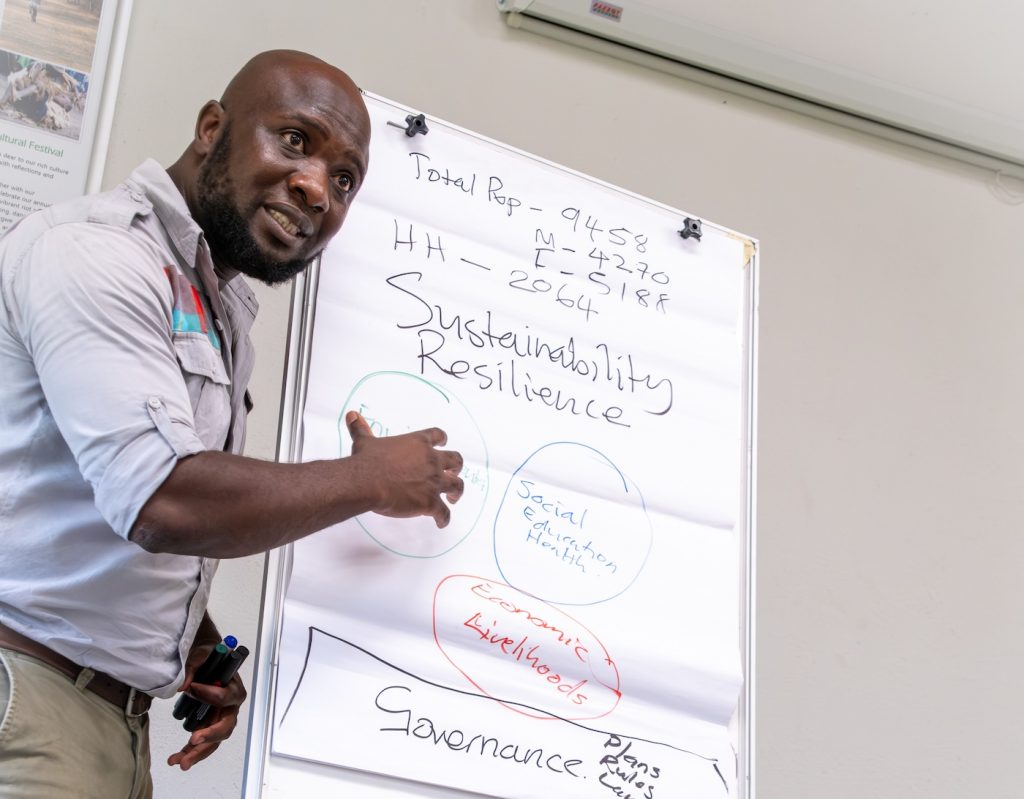
“We are not there to deliver PowerPoints,” Lemson says with a smile. In communities where abstract diagrams don’t resonate, SAT-WILD uses props and local metaphors.

  • A sponge becomes a model of resilience – it can be squeezed but always bounces back, and it holds water for future use.
  • A three-legged cooking pot illustrates sustainable development: social, environmental, and economic “legs” must all be balanced, while governance provides the base.

By drawing on everyday objects, facilitators turn complex concepts into something tangible, memorable, and actionable. Group work, illustrations, and hands-on activities ensure that knowledge is not just shared but co-created.

Value indigenous knowledge

Too often, practitioners treat communities as “empty jars” to be filled with external expertise. Lemson rejects this model. “They already have water in their jars,” he insists. Communities bring rich indigenous knowledge and lived experience that must be woven together with scientific and technical insights.

By asking “What do you know about this?” facilitators create space for dialogue. That blending of perspectives doesn’t just build better solutions – it builds ownership. And ownership is what makes projects last beyond donor cycles.

Stay flexible

Development timelines are often tight, but rigid schedules rarely work on the ground. Community events, ceremonies, or farming activities may clash with planned workshops. Lemson’s advice: don’t force it.

“Be flexible to change, tailor-make activities to fit into their plans, and work with them,” he says. “We are not at war. We are one big family wanting to achieve greater work in the landscape.”

Facilitate for co-creation

Ultimately, Lemson sees his role not as leading but as facilitating. SAT-WILD doesn’t claim the project as its own. “It’s not our project – it’s their project,” he explains, referring to the communities and other partners, including Malipati Developmentt Trust, Ngwenyeni Community Environment & Development Trust, local Authorities, Gonarezhou Conservation Trust, Manjinji Bosman’s Community Conservation and Tourism Partnership and SAT-WILD “We are just coming as facilitators, working with them.”

That mindset transforms relationships. It shifts from top-down instruction to shared problem-solving. It builds resilience not only in communities but also in the partnerships that support them.

Conclusion: A role model for ILM

For practitioners working in Integrated Landscape Management, Lemson’s advice is clear: respect local structures, adapt communication, make learning practical, value indigenous knowledge, and remain flexible.

It sounds simple – and in many ways it is. But doing these things consistently, with patience and humility, is what allows trust to grow. And trust, as SAT-WILD’s experience shows, is the foundation of lasting change.